IT LOOKS LIKE an alien balloon. Except that it flies at 17,500 mph in near-Earth orbit and can carry a science experiment—potentially your science experiment—for two months before it burns up in the atmosphere. And early next year, 20 of these ThumbSats will beam data back to a network of 50 listening stations all over the world. […]
Each mini satellite measures 16 inches and includes a micro camera and GPS. Aerospace engineer Shaun Whitehead is putting a $15,000 price tag on each ThumbSat's launch cost. (Photo : Cristiano Rinaldi)
IT LOOKS LIKE an alien balloon. Except that it flies at 17,500 mph in near-Earth orbit and can carry a science experiment—potentially your science experiment—for two months before it burns up in the atmosphere. And early next year, 20 of these ThumbSats will beam data back to a network of 50 listening stations all over the world.
Aerospace engineer Shaun Whitehead came up with the ThumbSat project because he wanted to help regular people send stuff into space. “We get slowed down by old-school ways of thinking,” he says. “I hope that ThumbSat accelerates progress in space, inspires everyone to look up.” His craft are so small that they fit into the nooks and crannies of commercial launchers, hitching a ride with bigger payloads and keeping costs down.
The people conducting the first experiments are a diverse group. Engineers at the NASA Jet Propulsion Laboratory hope to use a cluster of connected ThumbSats to study gravitational waves. Three teenage sisters from Tennessee who go by the moniker Chicks in Space want to orbit algae and sea monkey eggs. Artist Stefan G. Bucher will deploy magnetized fluids and shape-memory alloys.
Eventually a global network of volunteers, including a Boy Scout group in Wisconsin and a school in the Cook Islands, will monitor all the ThumbSat data. (Without receivers on those remote islands, there’d be a big gap in coverage out in the South Pacific.) Space is the place, and pretty soon anyone will be able to reach it.
What is LCRD? It is Laser Communications Relay technology, which NASA aims to fly on a test mission within four years and will be used in near-earth and deep-space human and robotic missions. Space laser communications technology has the potential to provide 10 to 100 times higher data rates than traditional radio frequency systems for the […]
What is LCRD? It is Laser Communications Relay technology, which NASA aims to fly on a test mission within four years and will be used in near-earth and deep-space human and robotic missions. Space laser communications technology has the potential to provide 10 to 100 times higher data rates than traditional radio frequency systems for the same mass and power. In short, laser communications could boost space data transmission rates from the speeds of dial-up to broadband.
The technology is directly applicable to the next generation of NASA’s space communications network. After the demonstration, the developed space and ground assets will be qualified for use by near-Earth and deep space missions requiring high bandwidth and a small ground station reception area.
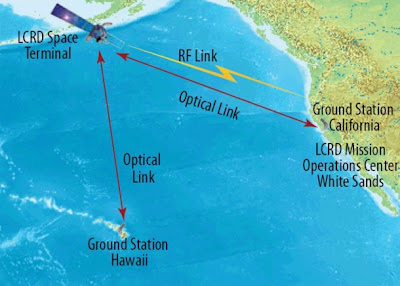
When launched, NASA’s technology demonstration payload will be positioned above the equator, a prime location for line-of-sight to other orbiting satellites and ground stations. Positioning LCRD aboard the commercial communication satellite platform is a cost effective approach to place LCRD in orbit. The Loral satellite will provide the right location, space availability, and power systems needed to conduct the space laser communications tests.
If you are interested in this topic, ATI offers Satellite Laser Communications course that will be presented on February 5-7, 2012 in Columbia, MD.
You can submit your registration here.
Cookie Consent
We use cookies to improve your experience on our site. By using our site, you consent to cookies.
Contains information related to marketing campaigns of the user. These are shared with Google AdWords / Google Ads when the Google Ads and Google Analytics accounts are linked together.
90 days
__utma
ID used to identify users and sessions
2 years after last activity
__utmt
Used to monitor number of Google Analytics server requests
10 minutes
__utmb
Used to distinguish new sessions and visits. This cookie is set when the GA.js javascript library is loaded and there is no existing __utmb cookie. The cookie is updated every time data is sent to the Google Analytics server.
30 minutes after last activity
__utmc
Used only with old Urchin versions of Google Analytics and not with GA.js. Was used to distinguish between new sessions and visits at the end of a session.
End of session (browser)
__utmz
Contains information about the traffic source or campaign that directed user to the website. The cookie is set when the GA.js javascript is loaded and updated when data is sent to the Google Anaytics server
6 months after last activity
__utmv
Contains custom information set by the web developer via the _setCustomVar method in Google Analytics. This cookie is updated every time new data is sent to the Google Analytics server.
2 years after last activity
__utmx
Used to determine whether a user is included in an A / B or Multivariate test.
18 months
_ga
ID used to identify users
2 years
_gali
Used by Google Analytics to determine which links on a page are being clicked
30 seconds
_ga_
ID used to identify users
2 years
_gid
ID used to identify users for 24 hours after last activity
24 hours
_gat
Used to monitor number of Google Analytics server requests when using Google Tag Manager
1 minute
Vimeo is a video hosting platform for high-quality content, ideal for creators and businesses to showcase their work.


 When launched, NASA’s technology demonstration payload will be positioned above the equator, a prime location for line-of-sight to other orbiting satellites and ground stations. Positioning LCRD aboard the commercial communication satellite platform is a cost effective approach to place LCRD in orbit. The Loral satellite will provide the right location, space availability, and power systems needed to conduct the space laser communications tests.
If you are interested in this topic, ATI offers Satellite Laser Communications course that will be presented on February 5-7, 2012 in Columbia, MD.
You can submit your registration here.
When launched, NASA’s technology demonstration payload will be positioned above the equator, a prime location for line-of-sight to other orbiting satellites and ground stations. Positioning LCRD aboard the commercial communication satellite platform is a cost effective approach to place LCRD in orbit. The Loral satellite will provide the right location, space availability, and power systems needed to conduct the space laser communications tests.
If you are interested in this topic, ATI offers Satellite Laser Communications course that will be presented on February 5-7, 2012 in Columbia, MD.
You can submit your registration here.